
2025 Archimedes Dinner Recognizes Donors and New Endowed Professors, including Prof. Zussman
By Allison Elliott
Columbia Engineering honors donors and its newest named professors with a dinner featuring the Archimedes Lecture with Wang Family Professor Steven Feiner.
Columbia Engineering hosted the 2025 Archimedes Dinner and Lecture Nov. 13, honoring faculty members who have recently received endowed professorships, along with their respective donors. Eight faculty members were recognized in a ceremony in Low Library, which included the annual Archimedes Lecture, given by Steven Feiner, Wang Family Professor of Computer Science.
Dean of Columbia Engineering, Shih-Fu Chang, who MC’d the event, greeted guests and articulated the importance of faculty support.
“Endowed professorships are a crucial part of our mission,” said Dean Chang. “They enable our faculty to continue the critical research that will have a lasting impact on society. From healthcare and climate to artificial intelligence and computational science, the named professorship supports groundbreaking research being done at Columbia Engineering that translates into major real-world impact.”
Acting President of Columbia University Claire Shipman also spoke to attendees and acknowledged University Trustee Fermi Wang MS’89, PhD’91, who endowed the Wang Family Professorship, and Columbia Engineering Alumni Association President Reid Ellison BS’08, for their efforts on behalf of the Engineering School. She praised how the School is “leading the way” in research breakthroughs and how the night’s honored professors are “building a foundation for the kind of long-term, big-picture thinking that advances human knowledge in thrilling and unexpected ways.”
The faculty honored represent five departments at Columbia Engineering: Computer Science, Earth and Environmental Engineering, Electrical Engineering, Mechanical Engineering, and Industrial Engineering and Operations Research. Each endowed professor thanked their donors and shared a brief sketch of their research. The evening concluded with the Archimedes Lecture delivered by Feiner, a longtime member of the Department of Computer Science faculty. Feiner shared insights from his research in augmented reality, virtual reality, and wearable computing. He thanked Wang, also present, for his support of his work. Wang, who completed his PhD at Columbia Engineering in electrical engineering, is CEO and co-founder of Ambarella Inc., a fabless semiconductor company and global leader in edge AI and computer vision. Currently serving on Columbia University’s Board of Trustees and on Columbia Engineering’s Board of Visitors, he was the 2018 recipient of the Thomas Egleston Medal from Columbia Engineering for his distinguished engineering achievement.
WiMNet lab director, Prof. Gil Zussman, was among the eight faculty recognized in the ceremony:
Gil Zussman
Kenneth Brayer Professor of Electrical Engineering
(Donor: Kenneth Brayer MS’65)
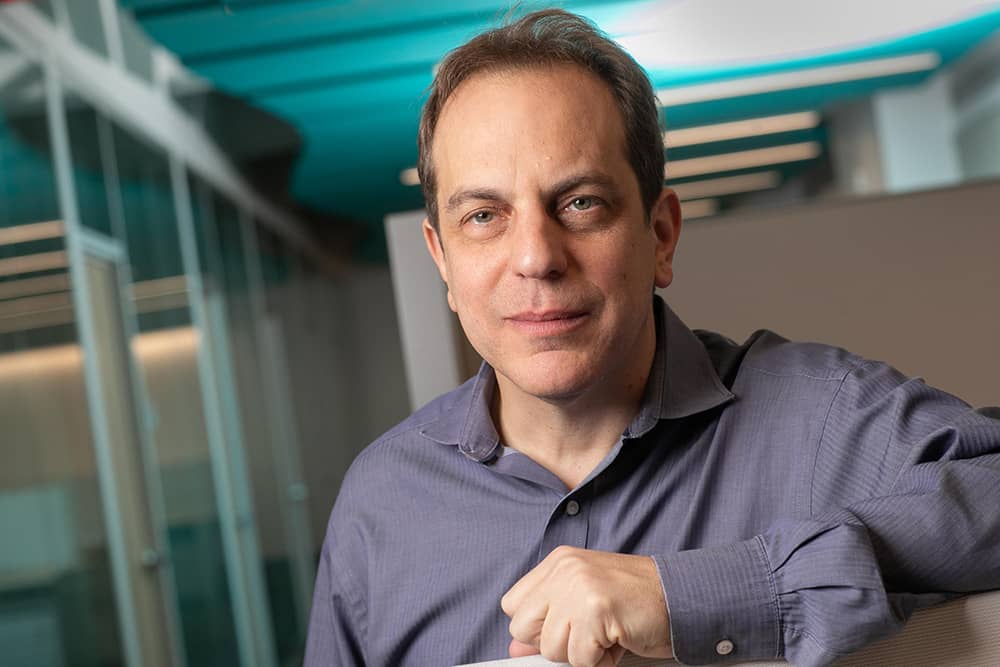
Gil Zussman received the BSc degree in industrial engineering and management and the BA degree in economics (both summa cum laude) from the Technion – Israel Institute of Technology in 1995. He received the MSc degree (summa cum laude) in operations research from Tel-Aviv University in 1999 and a PhD degree in electrical engineering from the Technion – Israel Institute of Technology in 2004. Between 1995 and 1998, he served as an engineer in the Israel Defense Forces. Between 2004 and 2007, he was a postdoctoral associate at MIT.
Since 2007, he has been with Columbia University, where he is now Kenneth Brayer Professor of Electrical Engineering, chair of the electrical engineering department, professor (affiliated) of computer science, and member of the Data Science Institute. His research interests are in the area of networking, and in particular in the areas of wireless, mobile, and resilient networks. He has been the Columbia PI of the ~$18M NSF COSMOS testbed, which is a national wireless infrastructure that is being deployed in West Harlem and enables experimentation in wireless and optical networks, edge cloud computing, and smart cities. The testbed has served as a foundation for the NSF Center for Smart Streetscapes (CS3) Engineering Research Center (ERC) at Columbia.
Zussman is an IEEE Fellow and a member of the American Academy of Sciences and Letters. He was an associate editor of IEEE/ACM Transactions on Networking, IEEE Transactions on Control of Network Systems, and IEEE Transactions on Wireless Communications and the Technical Program Committee (TPC) co-chair of IEEE INFOCOM’23, ACM MobiHoc’15, and IFIP Performance 2011. He received the Knesset (Israeli Parliament) Award for distinguished students, two Marie Curie International Fellowships, the Fulbright Fellowship, the DTRA Young Investigator Award, and the NSF CAREER Award and is a co-recipient of eight best paper awards.