
Three WiMnet Alums Receive a $3.5M NSF Grant
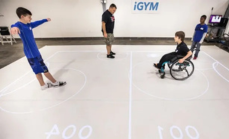 Columbia Electrical Engineering alumni and faculty are central to a new NSF-funded project solving network latency to make therapeutic AR/VR games more responsive.
Research from a multi-university team, including Columbia Engineering, is tackling the network latency that can disrupt immersive virtual and augmented reality experiences, with a focus on therapeutic games for rehabilitation.
The project aims to make VR/AR systems more responsive for applications like an adaptive soccer game for wheelchair users and a cognitive-physical word puzzle for individuals with Parkinson’s disease.
This collaborative effort is led by WiMNet lab alumna Prof. Jiasi Chen (EE B.S.’09) at the University of Michigan and also includes WiMNet lab alumni Prof. Maria Gorlatova (Ph.D. ’15) and Prof. Tingjun Chen (M.S. ’18, Ph.D. ’20) at Duke University. At Columbia, Ethan Katz-Bassett, associate professor of electrical engineering, and Kostis Kaffes, assistant professor of computer science, lead the Columbia thrust of the project, which focuses on selecting servers and optimizing Internet paths to deliver data fast enough for immersive, seamless gameplay.
The work is funded by a $3.5 million National Science Foundation grant.
For the full story, visit: Games for Rehab, Fast Communication for Interactive VR and AR
By Xintian Tina Wang