
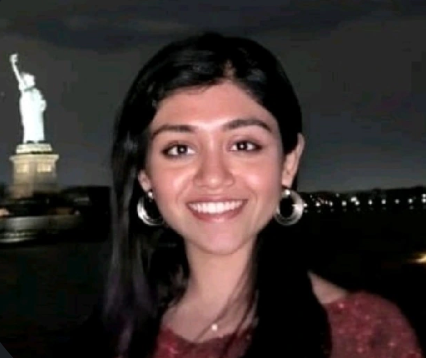
Shivalee RK Shah
Ph.D. Student
Co-advised by Prof. Gil Zussman and Prof. Sebastian Will
Electrical Engineering
Columbia University
Office: 801 CEPSR
Email: srs2337[at]columbia.edu
Shivalee Shah received her B.Tech. in Mechanical Engineering and Artificial Intelligence from IIT Jodhpur in 2024, where she was awarded the Director’s Gold Medal, and her M.S. in Quantum Science and Technology from Columbia University in 2025 (with Honors). Her research interests span distributed quantum computing, quantum networking architectures, quantum memories, and quantum transducers for interconnecting heterogeneous quantum systems.
Education
Columbia University
- PhD in Electrical Engineering (Jan 2026- Present)
- MS in Quantum Science and Technology – 4.026/4.0
- MS Research Award – 2026
- MS Honors
Indian Institute of Technology, Jodhpur
- B.Tech in Mechanical Engineering with a Minor in AI – 8.42/10
- Director’s Gold Medalist
Publications
- Shah, S., & Vatsa, M. (2024). Enhancing Quantum Diffusion Models with Pairwise Bell State Entanglement. In Proceedings of the 2024 International Conference on Pattern Recognition (ICPR) (pp. 347–361). Springer
Work Experience
Quantum Data Science Intern at Decimal Point Analytics
- Collected and analyzed supply chain data across multiple client sites; benchmarked quantum algorithms (QAOA) against classical routing methods using Python and Qiskit, achieving an 84.29% improvement in cost efficiency.
- Built a reproducible benchmarking pipeline with automated data processing and GitHub-based version control, enabling scalable evaluation across distributed sites.
Research Experience
SCY-Net (NQVL, NSF-Funded)
- Assembled and commissioned the quantum-enabled node at Columbia, integrating WDMs and timing synchronization infrastructure; characterized timing jitter to establish synchronization baselines for quantum network operation.
- Conducted polarization characterization of deployed fiber links; developed analysis scripts to quantify short-term fluctuations and long-term drift; presented findings at the SCY-QNet collaboration townhall.
- In collaboration with Prof. Gaeta’s group, initiated quantum decoy-state experiments to measure QBER, laying groundwork for photonic chip-integrated qubit sources.
Universal Quantum Compiler
- Developing a hardware-agnostic compiler platform under Prof. Rubenstein and Prof. Yuen, with an LLVM-inspired pipeline featuring optimizations such as qubit mapping, gate scheduling, and movement heuristics.
- Creating methods to translate algorithms across heterogeneous hardware, efficiently mapping circuits from one architecture to another while preserving performance and resource efficiency.
Sensing using Diamond NV Center (Pasupathy Lab)
- Probed bilayer and trilayer CrSBr flakes using diamond NV centers to map layer-dependent stray magnetic fields across temperature.
- Located flakes via photoluminescence imaging and performed CW/pulsed ODMR, ESR, and Rabi measurements to extract spin coherence (T_2) and magnetic field variations.
- Optimized 532 nm confocal setup with AOM, dichroic beam splitters, and SNSPD detection for high-resolution spin readout.
Teaching Experience
- Teaching Assistant for Quantum Engineering (EECS 6890)
- Course Assistant for Numerical Methods (APMAE4300)
Mentorship
MS Students
- Kate Bonner(MS in QST ) and Emilia Jhonson (MS in EE), Jan 2026- May 2026
Undergrad Students
- Shreya Jan 2026- Present
High School Students