
Alon Levin recieved a Best Poster Award in the Pioneering Israeli Science Conference (PISC)
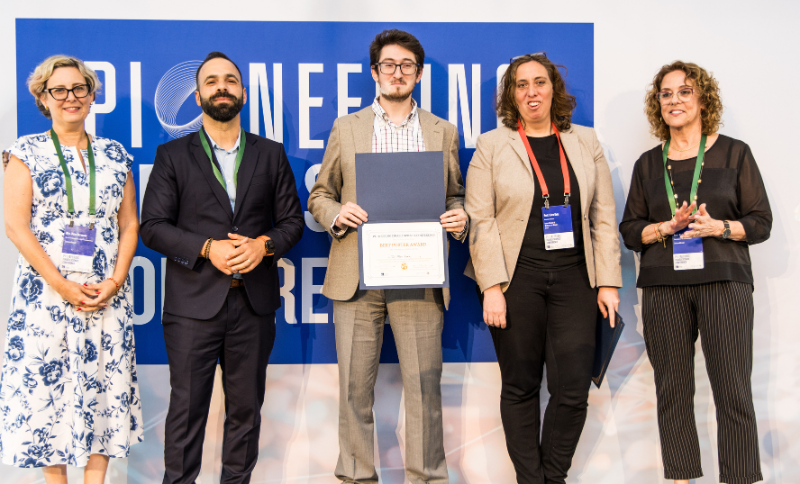
WiMNet lab PhD student Alon Levin received the Best Engineering Poster Award for the poster “Enabling Practical Full-Duplex Wireless: from Circtuit to Software” presented at the Pioneering Israeli Science Conference (PISC). The poster is based on joint work with Dr. Manav Kohli, Prof. Igor Kadota, Prof. Gil Zussman and the rest of the FlexiCon project team.
The poster abstract: As wireless traffic grows exponentially and significantly more devices compete for access to network resources, the next generation of communications infrastructure requires a radical rethinking. A promising solution that has received significant focus in recent years is full-duplex wireless, a paradigm by which devices transmit and receive simulta- neously on the same frequency channel — promising to double data rates and increase spectral and energy efficiency compared to existing wireless networks. Meaningful advances over the past decade have introduced hardware prototypes, network-layer protocols, and self-interference cancellation schemes — all critical components that bring us one step closer to realizing full-duplex wireless. Nevertheless, the translation from academic works to practical implementations capable of operating in real-world communications systems notably lags. The FlexICoN project at Columbia University bridges this gap through interdisciplinary research spanning the full communication stack. At its core, we have developed three generations of full-duplex radios — each built around a custom integrated circuit canceller of increasing sophistication — and a complete software control stack imple- mented in GNU Radio, an open-source platform widely used in wireless research. To open the field beyond our own scope, we integrated these radios into the ORBIT and COSMOS wireless testbeds — open-access platforms that are remotely accessible to researchers anywhere in the world. The work presented, from the small-form-factor cancellation circuitry to the intelligent environment-aware optimization algorithms, represents a comprehensive framework for implementing practical fullduplex wireless and a roadmap for eventual integration into tomorrow’s wireless standards.