
Dr. Jhonatan Tavori Recieved the Sagol Best Poster Award in the 2026 Mind-IL Computer Science Conference
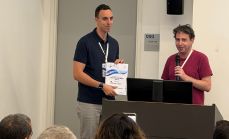 Dr. Jhonatan Tavori, a Postdoctoral Research Scientist in the WiMNet lab has received the Sagol Best Poster Award in the 2026 Mind-IL Computer Science Conference. The ‘2026 Mind-IL Computer Science Conference in Memory of Prof. Michael O. Rabin’ took place in Tel Aviv, Israel on October 26, 2026. The event was part of the Israeli Science and Academia Week, a series of academic conferences and research meetings held from October 25-26, 2026.
As part of the conference, postdocs were invited to present their postdoctoral research in a poster session, and a prize committee selected the best poster. Jhonatan’s poster, “Resilience and Performance of Emerging Edge-Cloud AI
Systems Under Adversarial Conditions” examined how attacks on computing capacity, inference timing, and data integrity can degrade smart-city and AI applications, highlighting the role of network behavior in what these systems can guarantee under attack. The poster is based on the following projects with collaborators from Columbia, the NSF Center for Smart Streetscapes (CS3) Engineering Research Center, and UC Berkeley.
(1) “Worst-Case Attacks in Reactive Edge-Cloud Systems: Expected Latency and SLA Violation” (J. Tavori, M. K. Turkcan, Z. Kostic, J. Ghaderi, and G. Zussman, IEEE INFOCOM 2026), which studied worst-case attack strategies on edge servers in reactive edge-cloud deployments; (2) “Denial of Deadline: Network-Driven Accuracy Collapse in Distributed Inference Pipelines” (J. Tavori, G.-E. Sela, I. Stoica, and G. Zussman, arXiv 2026 ), which revealed how network workload attacks can collapse the accuracy of distributed inference systems; and (3) “Digital Eyes on the Road: Using Street Cameras to Verify Traffic Integrity and Detect Sybil Attacks at City Scale” (J. Tavori, M. Turkcan, Z. Kostic, S. Stolfo, and G. Zussman, USENIX VehicleSec 2026), which proposed a method for detecting Sybil attacks on navigation platforms using smart-city street cameras.
This line of work utilized the NSF PAWR COSMOS testbed and used its city-scale camera pipeline to evaluate the research under real urban conditions. This research is part of the NSF Center for Smart Streetscapes (CS3) ERC and reflects a collaboration across CS3 Thrust 1 (Connectivity) and Thrust 3 (Security).